ResearchDart is the routing layer between sample suppliers and buyer surveys. It checks each respondent before the first question, records how every session ended, and gives both sides the same reasons when a complete is thrown out.
Device, network and automation signals before the survey opens
Signed redirects
HMAC-verified entry links and endlinks
GDQ-coded reversals
The industry's 18 standard removal reasons
Live sessions Job 26-0418Enforcing
Entries today
1,842
Screened out
11.4%
Completes
412
Incidence
34%
Time (ET)
Supplier
Signals
Decision
10:42:07 AM
1188
None
Passed
10:41:52 AM
1263
vpndatacenter
Blocked
10:41:33 AM
1042
None
Passed
10:41:26 AM
1188
quota_full
Over quota
10:40:58 AM
1042
None
Passed
10:40:41 AM
1263
multiple_accounts
Flagged
Console view with illustrative data
Works with any survey platform that can redirect
Qualtrics
Forsta Decipher
Alchemer
Voxco
SurveyMonkey
LimeSurvey
Custom surveys
Quality is decided at three moments
Most bad data is cheaper to stop at the door than to clean afterwards. ResearchDart covers the whole session, from the entry link to the invoice.
Before the survey
Pre-survey screening
The respondent's browser is checked while a short holding page loads. Automated browsers, anonymised networks and people already in the study are stopped before they cost a buyer anything.
Each supplier works the project through its own allocation, entry link and quota. Closed cells return respondents immediately, and the survey reports outcomes on signed endlinks.
Completes that fail cleaning are reversed with a Global Data Quality code, so suppliers see exactly why and can act on the source instead of arguing about the invoice.
Stop AI agents before they read your first question
Survey-taking agents now pass attention checks and write fluent open ends. The signals that still give them away are in the browser and the network, which is why ResearchDart checks there, before the survey loads.
Projects, allocations, sandbox tests, quality reports and reversals without writing code.
REST API
Create projects, pull live surveys, report outcomes and reverse completes programmatically.
Managed setup
We configure redirects and screening with your team and run the first sandbox tests together.
An API that matches how fieldwork runs
Suppliers pull live surveys with payout and remaining completes. Buyers report outcomes server-to-server and reverse completes with standard codes. Every call is scoped to one account key.
# Supplier: surveys open to your panel right now
curl https://researchdart.com/api/v1/supplier/surveys \
  -H "Authorization: Bearer rd_…"

{
  "project_code": "RDK7M2QX",
  "country": "US",
  "loi_minutes": 12,
  "payout": "1.75",
  "completes_remaining": 588,
  "entry_link": "…/s/entry/k3m9q2xa7hpd?rid={RID}"
}
# Buyer: record a complete without exposing a redirect
curl -X POST https://researchdart.com/api/v1/buyer/transactions/01k8zq4r2m…/status \
  -H "Authorization: Bearer rd_…" \
  -d status=complete

{ "recorded": true, "data": { "status_code": 10 } }
# Buyer: reverse a complete after cleaning
curl -X POST https://researchdart.com/api/v1/buyer/transactions/01k8zq4r2m…/reversal \
  -H "Authorization: Bearer rd_…" \
  -d gdq_code=15 -d note="OE2 copied from a chatbot"

{ "reversed": true, "data": { "reversal": { "gdq_label": "Open end: AI completed" } } }
Straight answers before you talk to us
Most sample websites tell you what you want to hear. These are the things we would rather you knew up front.
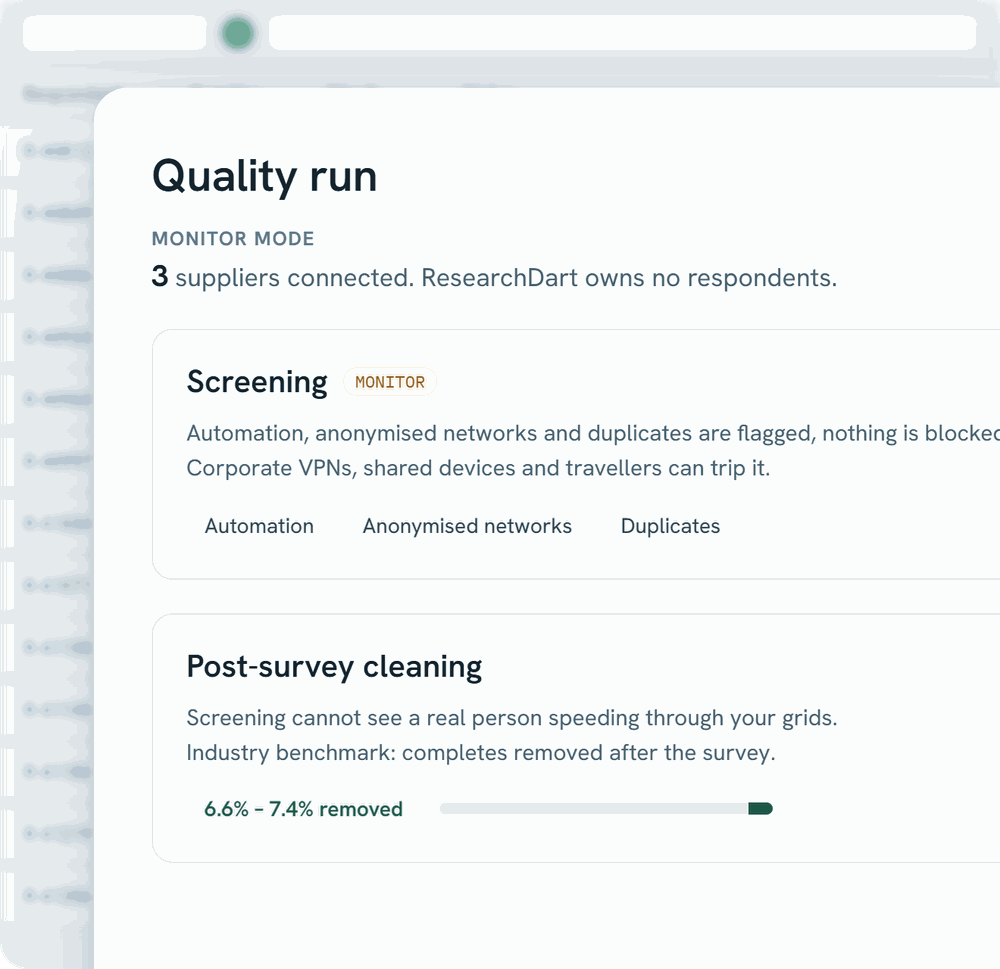
Monitor mode, before anything is enforced. Illustrative data.
We are not a panel
ResearchDart does not own respondents. They come from the suppliers connected to your project, and their quality is only as good as those suppliers and the checks you switch on.
Screening will not replace cleaning
It stops automation, anonymised networks and duplicates. It cannot see a real person speeding through your grids. Industry benchmark data still shows 6.6% to 7.4% of completes removed after the survey.
It will block some real people
Corporate VPNs, shared devices and travellers produce false positives. That is why every project can run in monitor mode before it enforces anything.
The numbers on this site are illustrative
Console screenshots use example data. We do not publish panel sizes, customer counts or fraud rates we cannot show you evidence for.
Sometimes one panel is the better buy
Trackers, recontact studies and simple high-incidence work are often better served by a single panel. We explain when.